A nameplate flow rate does not tell you whether reverse osmosis will lower water costs or create a costly reject stream. By the end, you will be able to compare treatment options, size the system from actual demand, define the required pretreatment, and calculate whether the complete installation earns its place in your factory.
Key takeaways
- Define the process-water specification before choosing an RO plant.
- Compare RO with filtration, softening, and demineralisation for your actual feed water.
- Size production, storage, peak demand, and reject-water handling together.
- Include pretreatment, membranes, energy, maintenance, and disposal in industrial RO plant cost.
Start with the factory’s water problem, not the RO nameplate
An industrial RO plant for factory use solves a real operational need when your current water supply cannot reliably meet a defined process-water specification at the required daily volume.
Compare actual consumption, peak demand, operating hours, feed-water quality, purchased-water or tanker costs, production losses during shortages, and the cost of disposing of reject water—not just the quoted litres-per-hour capacity.
Use this decision checklist before requesting a design:
- Define the product-water limit: conductivity or TDS, hardness, silica, chloride, and microbiological targets for boilers, cooling towers, rinsing, production, or laboratory use.
- Record daily and hourly demand, including shift changes, washdowns, batch operations, and future production increases.
- Test feed water for conductivity/TDS, hardness, alkalinity, silica, iron, manganese, turbidity, SDI, temperature, free chlorine or other oxidants, and microbiological condition.
- Sample across seasons and supply sources; a borewell change or monsoon shift can alter recovery, pretreatment, and membrane life.
- Price the complete alternative: water purchase, tanker delays, downtime, pretreatment, power, chemicals, membrane replacement, operator time, testing, cleaning, reject disposal, storage, and post-treatment.
The strongest industrial RO benefits appear when unreliable or expensive water threatens production, or when a simpler treatment route cannot meet the specification. Reject volume must fit your drain, recovery, reuse, or concentrate-treatment plan; higher recovery saves water but raises scaling risk.
If the factory only needs suspended-solids removal or hardness control, filtration or softening may solve the problem at lower complexity.
When is RO better than filtration, softening, or demineralisation?
Choose RO when your feed water contains dissolved salts and your finished-water specification limits conductivity, TDS, hardness, or specific ions; choose a simpler process when those contaminants are not the problem.
| Option | What it removes | When it applies |
|---|---|---|
| Multimedia filtration | Suspended solids and turbidity | Clear muddy or particulate-laden water before downstream treatment; it does not lower TDS. |
| Activated carbon | Chlorine, taste, odour, and some organic compounds | Protects membranes from oxidant damage or treats organics; it does not soften water. |
| Softening | Calcium and magnesium hardness | Prevents scale in boilers, cooling systems, and RO pretreatment when low salt content is not required. |
| Demineralisation | Dissolved ions through cation and anion exchange | Produces low-conductivity water, but resin regeneration, chemical handling, and leakage control add operating work. |
| RO | Most dissolved salts, hardness, many metals, and microorganisms | Fits boiler feed, process rinsing, food production, and electronics water when the specification demands broad salt reduction. |
Industrial RO water purification is not a universal substitute. Volatile compounds, dissolved gases, and some low-molecular-weight organics may require air stripping, activated carbon, ion exchange, electrodeionisation, UV, or another polishing stage.
Match the complete train to the tested feed water and specification: filtration or carbon before RO, then storage and disinfection or polishing after it. The industrial RO plant benefits disappear if concentrate disposal is expensive; at 75% recovery, 100 m³ of permeate creates about 33 m³ of reject, excluding flushing and cleaning losses.
Size the plant from peaks, storage, and reject-water volume
Size a ro plant for manufacturing unit demand from its busiest hour and shift, not from the brochure’s litres-per-hour figure. A daily average hides washdowns, batch starts, boiler make-up, cooling-tower replacement, and CIP events that arrive together.
Map the demand profile across operating hours. Compare the peak requirement with the RO’s actual production after cleaning, maintenance, and seasonal feed-temperature changes. If production cannot follow the peak, size permeate storage for the shortfall and define the tank’s usable volume, not just its gross capacity.
Collect these figures before accepting a quotation:
- Per-hour demand during normal production
- Maximum simultaneous demand during batches, washdown, boiler filling, or CIP
- Shift length and hours available for RO operation
- Required storage volume and refill time
- Permitted reject-water volume and disposal route
Your configuration changes the risk as well as the capacity:
| Option | Strength | Trade-off |
|---|---|---|
| Single large train | Lower equipment cost per cubic metre | One fault can stop production |
| Parallel trains | Partial output during maintenance | Higher capital and controls cost |
| RO with permeate tank | Covers short demand peaks | Requires tank space, sanitation, and level controls |
Recovery determines reject volume. At 75% recovery, producing 1,000 litres of permeate creates about 333 litres of concentrate. Raising recovery reduces discharge but concentrates salts at the membrane tail, increasing scaling risk. Approve the design only after checking peak demand, tank autonomy, recovery chemistry, and the factory’s daily reject-water capacity.
Test the feed water and protect the membrane
Do not approve a design from a TDS figure alone. A factory’s industrial RO water purification system needs laboratory results from each source, with samples repeated across seasons or wells. The right RO plant for a manufacturing unit depends on the worst credible feed condition, not today’s clear-looking water.
1. Test conductivity or TDS, temperature, hardness, alkalinity, silica, iron, manganese, turbidity, SDI15, free chlorine and other oxidants. Record pH, microbiological condition, flow, operating hours, and seasonal variation.
2. Set design limits before selecting membranes. For many brackish-water systems, specify SDI15 below 5; lower is better. High turbidity, colloids, metals, or biofouling pressure can shorten membrane life even when TDS is acceptable.
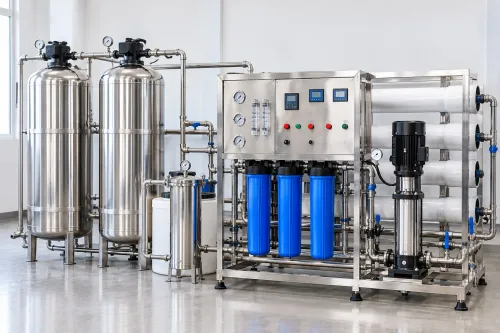
3. Build the pretreatment sequence around the results: screening, multimedia filtration for suspended solids, activated carbon or sodium metabisulfite for chlorine removal, and softening or antiscalant dosing for hardness and scale-forming salts. A cartridge filter alone cannot stop chlorine damage to polyamide membranes.
4. Require a design water balance showing feed, permeate, recovery, concentrate volume, reject disposal, and cleaning waste. Reject storage or a permitted drain connection belongs in the design, not as an afterthought.
5. Specify downstream controls: permeate conductivity, flow, pressure, recovery, tank level, and alarms, plus UV, ozone, chemical sanitation, hygienic tanks, recirculation, or polishing when product-contact water demands them. Sample the tank and distribution loop; RO does not prevent recontamination through vents, dead legs, or piping.
Calculate the complete cost before deciding
Compare annualised ownership cost with the cost of water failure, not with the quoted skid price. Divide the installed cost, civil works, tanks, electrical panels, piping, commissioning, and financing by the expected service life, then add power, antiscalant, cleaning chemicals, membranes, laboratory tests, operator time, maintenance, reject disposal, and post-treatment.
| Cost or value item | Include in your calculation | Why it changes the decision |
|---|---|---|
| Capital | RO skid, pretreatment, storage, pumps, installation, civil and electrical work | A low quotation can exclude the equipment that makes the system usable |
| Running cost | Electricity, chemicals, membranes, testing, labour and sanitation | These recurring costs determine the real cost per usable litre |
| Water value | Purchased water, tanker charges, sewer fees and reject disposal | Recovery reduces reject volume but higher recovery can increase scaling and cleaning |
| Failure cost | Downtime, rejected batches, boiler problems, production delays and emergency supply | Reliable specification-compliant water has value beyond its purchase price |
Calculate cost per usable litre, not per litre produced. Include the reject stream at the designed recovery and price concentrate disposal, especially where drain capacity is limited. Compare the result with tanker water, municipal supply, or an alternative treatment train.
The industrial RO plant benefits are strongest when inconsistent supply or off-spec water interrupts production. Confirm that permeate meets the actual conductivity, hardness, silica, microbiological, or process limit; RO alone does not control every dissolved gas or contaminant.
Ask Orenus Water age technology for a line-item quotation showing exclusions, design-feed analysis, guaranteed permeate quality, recovery, reject flow, replacement intervals, and post-treatment responsibilities. That document makes industrial RO plant cost comparable with the value your factory can actually capture.
Related products
 | RO Water Plant RO Capacity 500-1000 (Liter/hour) Material Stainless Steel Automation Grade Automatic Usage/Application Industrial Max Water Recovery Rate 65-70 %... View product → |
 | Mineral Water Plant RO Capacity(Litre/Hr) 1000 LPH Material FRP Automation Grade Semi Automatic RO Membrane Type Thin-Flim Composite (TFC) Media Activated Carbon + sand... View product → |
Frequently asked questions
When is an industrial RO plant better than filtration or softening?
RO is the stronger choice when you need substantial dissolved-solids reduction, while filtration removes suspended particles and softening targets hardness.
How do you size an RO plant for a manufacturing unit?
Use daily consumption, peak hourly demand, storage capacity, recovery rate, and reject-water volume rather than the nameplate output alone.
What feed-water tests are needed before installing industrial RO?
Test total dissolved solids, hardness, alkalinity, pH, turbidity, iron, manganese, silica, chlorine, and microbiological quality before selecting pretreatment and membranes.
What costs should an industrial RO plant calculation include?
Include equipment, pretreatment, installation, electricity, water recovery, membrane replacement, cleaning chemicals, labour, maintenance, and reject-water management.
Related products
 | Mineral Water Plant Material Stainless Steel Working Pressure 100 PSI RO Capacity 3000 ltr/hr Deliver Type Pan India Installation Service Yes Country of Origin Made in... View product → |
 | RO Water Plant Capacity 500 -10000 Material Stainless Steel Technology Japanese Brand ORENUS RO Capacity(Litre/Hr) 3000 LPH Usage/Application Water Purification... View product → |
Keywords