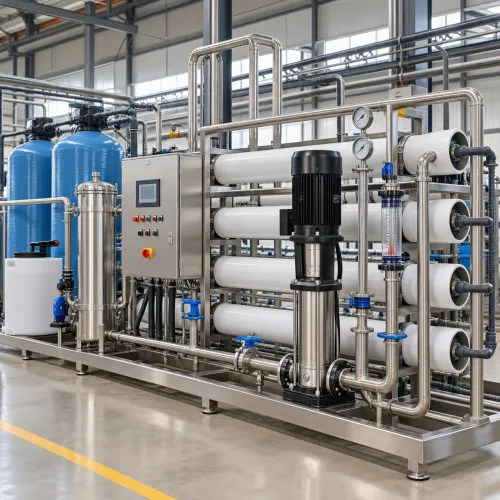
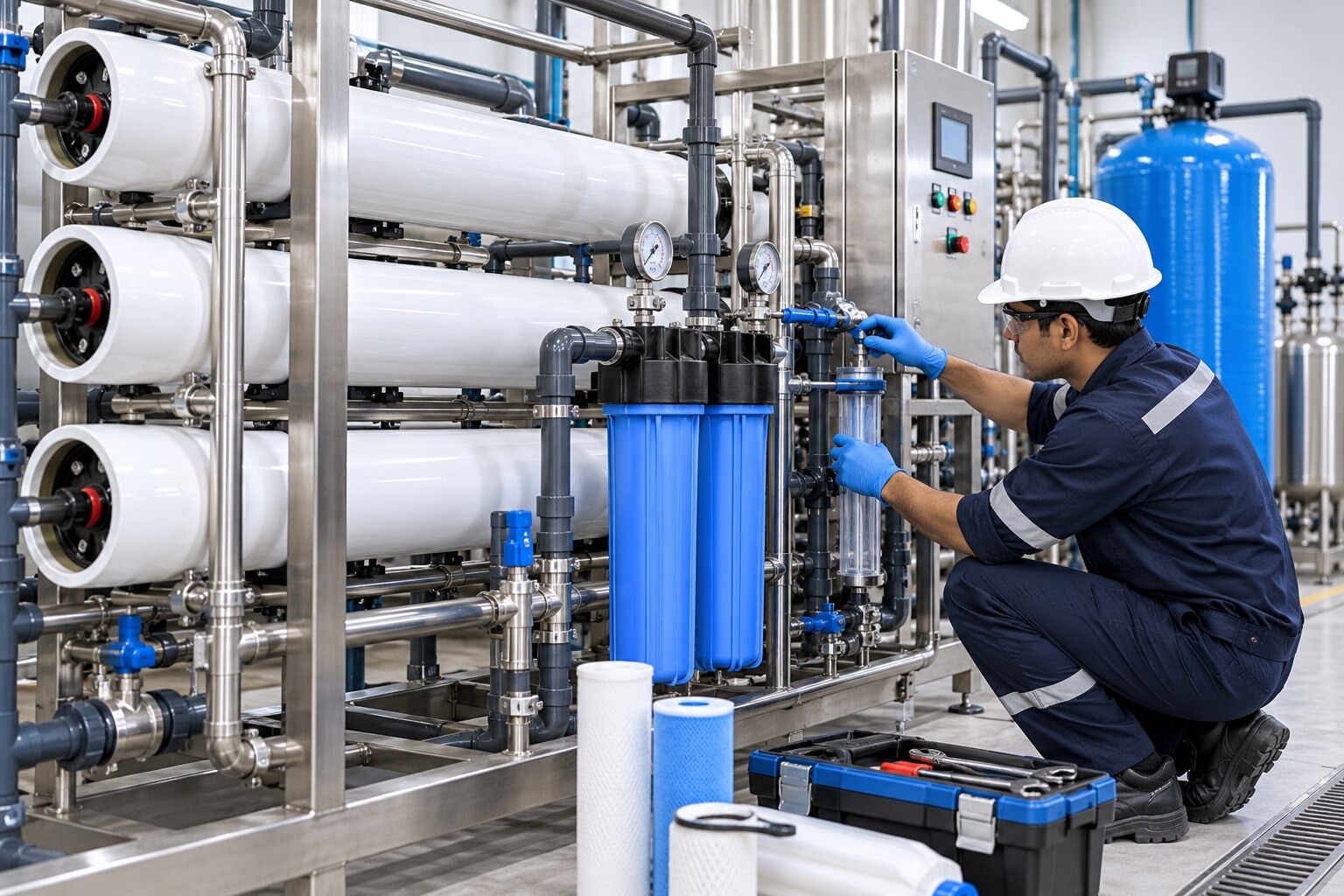
A commercial RO plant rarely fails without warning: pressure, flow, conductivity, differential pressure, chemical dosing, and water quality usually shift first. By following a measured service schedule and a defined fault-isolation process, you can decide when operators should adjust the plant, when production must stop, and when a technician or membrane replacement is justified.
Key takeaways
- Record feed, permeate, reject flow, recovery, pressure, TDS, and conductivity every shift.
- Stop production for abnormal pressure, sudden flow loss, leaks, unsafe water, or uncontrolled chemical dosing.
- Clean membranes only after confirming pretreatment performance and identifying the fouling type.
- Approve replacement after comparing normalized flow, salt rejection, cleaning history, and membrane age.
What operators should check before every shift
Release an RO plant only after confirming that today’s readings match its commissioned operating range and yesterday’s trend. Record feed, permeate, and reject flow separately; recovery equals permeate flow divided by feed flow. A rising recovery can indicate a blocked reject control or wrongly positioned valve, increasing scaling risk even when permeate TDS looks acceptable.
- Check feed pressure, permeate pressure, reject pressure, differential pressure across cartridge and multimedia filters, permeate flow, reject flow, conductivity or TDS, pH, and temperature.
- Compare permeate flow and salt passage after normalizing for temperature, feed pressure, feed TDS, and recovery. Raw readings alone can mistake cold seasonal water for membrane fouling.
- Inspect every hose, housing, union, pump seal, valve, and pipe joint for leaks. Stop for a chemical leak, exposed wiring, abnormal vibration, or pump noise.
- Confirm adequate antiscalant, acid, chlorine-control chemicals, and cleaning chemicals; test dosing pumps, dosing interlocks, level switches, and high- and low-pressure cut-outs.
- Confirm pretreatment pressure drop is within the plant’s recorded limit, reject flow is present, and no stagnant section remains after shutdown.
- Verify conductivity/TDS, pH, pressure, flow, and level instruments against a reference meter when a reading conflicts with the physical condition.
| Condition | Run decision | Required response |
|---|---|---|
| Readings within baseline; no leaks or alarms | Run | Record values and accept initial permeate only after stabilization |
| Flow or salt passage worsens after normalization | Investigate | Check pretreatment, instruments, pump, valves, and membranes |
| Chemical leak, missing reject flow, unsafe pressure, or failed interlock | Stop | Isolate the plant and call for reverse osmosis plant servicing; commercial RO maintenance should document the fault before restart. |
How to build a daily, weekly, monthly, quarterly, and annual maintenance schedule
A calendar alone will not protect an RO system. For a reverse osmosis plant for maintenance in Nagpur, tie every task to feed-water results, operating trends, and a written action limit for investigation or shutdown.
1. Daily: Record feed, permeate, and reject flow; feed and permeate pressure; differential pressure; conductivity or TDS; pH; temperature; chemical levels; and recovery. Note leaks, pump noise, vibration, valve position, and any alarm. Compare readings with the approved baseline, not yesterday’s result alone.
2. Weekly: Inspect and clean strainers, verify pretreatment backwash, check dosing pumps and tubing, and test level switches, high- and low-pressure cut-outs, and dosing interlocks. Record each test, its result, and the corrective action.
3. Monthly: Review normalized permeate flow and normalized salt passage, then inspect cartridge filters, electrical connections, reject-flow controls, and pressure gauges. Record replacements, calibration checks, cleaning chemicals, batch numbers, and recovery.
4. Quarterly: Verify conductivity/TDS meters, pH probes, flow meters, gauges, and switches against reference instruments. Test feed water for hardness, alkalinity, iron, silica, turbidity, and microbial loading when conditions change; update alarm limits if the source changes.
5. Annually: Service pumps, valves, dosing equipment, wiring, and safety controls; review the full trend log with a qualified technician. Document membrane cleaning or replacement and establish a restart procedure.
After any shutdown, inspect for leaks, confirm chemical dosing, flush stagnant sections where applicable, verify reject flow, and send initial permeate to drain until readings stabilize. Preserve membranes with the specified solution during extended idle periods, never untreated feed water.
When to stop production and how to identify the real fault
Stop production immediately if feed pressure, reject flow, normalized permeate flow, or permeate quality crosses your documented alarm limit. Shut down sooner for cavitation, overheating, abnormal vibration, leaks, chemical-dosing failure, or an electrical overload; continuing can destroy a pump or membrane.
- Record feed, permeate, and reject flow separately, then calculate recovery as permeate flow divided by feed flow. A rising recovery with falling reject flow points to a blocked reject-flow control or wrong valve position, which can cause scaling even while TDS still looks acceptable.
- Compare normalized permeate flow and normalized salt passage with the clean baseline. A gradual normalized-flow decline with higher salt passage indicates fouling or scaling; temperature, pressure, feed TDS, and recovery must be included before judging raw readings.
- Check pretreatment differential pressure, cartridge condition, turbidity, hardness, iron, silica, pH, and dosing. High pressure drop or poor feed quality identifies pretreatment failure, while low feed pressure with a clean filter suggests suction-side air ingress, pump wear, or a blocked line.
- Test the concentrate valve, inlet valve, pressure switch, and dosing pump independently. Confirm phase sequence, motor current, and overload status before replacing the high-pressure pump.
- Verify conductivity, pressure, and flow instruments against a calibrated handheld meter and a second gauge. One impossible reading is an instrument fault, not membrane failure.
- Compare current feed-water results with seasonal Nagpur records. Changes in borewell or municipal water temperature, alkalinity, hardness, turbidity, iron, silica, or microbial loading require adjusted pretreatment and cleaning decisions.
Use a technician for ro plant repair in nagpur when the cause remains uncertain. Restart only after correcting the fault, flushing to drain, confirming stable readings, and releasing water against the finished-water specification.
How to maintain pretreatment, backwash filters, and clean RO membranes
Protect the membrane by correcting pretreatment before increasing pressure or dosing more antiscalant. Record feed turbidity, hardness, iron, silica, pH, conductivity, temperature, flow, pressure, and cartridge differential pressure; seasonal borewell or municipal changes in Nagpur can alter these values.
1. Backwash multimedia, sand, or activated-carbon filters when differential pressure reaches the manufacturer’s limit, flow falls, or turbidity rises after the filter. Use the specified flow rate and duration, then rinse to drain until the outlet runs clear. Do not send unsettled backwash water to the RO.
2. Regenerate a softener when hardness leakage reaches its set limit or the calculated exchange capacity is exhausted. Confirm the brine tank has the correct salt and rinse completely; hardness breakthrough accelerates membrane scaling.
3. Replace cartridge filters at their specified pressure-drop limit or when loading causes bypass risk, not simply on a calendar date. Isolate and depressurise the housing, fit the correct micron rating, inspect the seal, and leak-test it before starting the high-pressure pump.
4. Chemically clean membranes when normalized permeate flow declines, normalized salt passage rises, or vessel pressure drop increases after pretreatment is confirmed. Use the membrane maker’s chemical, concentration, temperature, contact time, and pH limits; circulate at low pressure, never mix incompatible chemicals, and flush to drain.
Reverse osmosis plant servicing and commercial ro maintenance must include checking conductivity, pH, pressure, flow, level, cut-outs, and dosing interlocks against reference instruments. After cleaning or replacement, flush until preservative, chemicals, and abnormal conductivity disappear; release drinking water only against its finished-water specification and required microbiological tests.
How to choose a service provider and approve membrane replacement in Nagpur
Approve the technician’s diagnosis before approving the repair. For RO plant repair in Nagpur, require current feed and permeate conductivity or TDS, pH, temperature, flow, pressure, differential pressure, alarm history, and photographs of leaks or damaged parts.
The report must test alternatives such as blocked prefilters, suction-side air, dosing failure, concentrate-valve position, faulty probes, and electrical overloads.
| Stage | Evidence to approve | Reject if |
|---|---|---|
| Repair | Measured fault, test readings, failed-part identification, and corrective method | The recommendation says “service required” without locating the cause |
| RO membrane replacement in Nagpur | Normalized flow, salt passage, vessel pressure drop, cleaning history, and foulant analysis or element autopsy when justified | Replacement is based only on element age |
| Restart | Leak inspection, chemical and dosing checks, pretreatment pressure drop, reject-flow confirmation, and a flush record | The technician sends initial permeate to the tank |
| Water release | Stable readings after flushing preservative and cleaning chemicals, plus the applicable finished-water specification and required microbiological result | Conductivity alone is treated as proof of safety |
For a reverse osmosis plant for maintenance in Nagpur, ask for seasonal feed-water results covering hardness, alkalinity, turbidity, iron, silica, and microbial loading. Orenus Water age technology can be assessed by the same evidence: request a signed service report, replaced-part details, calibration status, reject-flow and drain-capacity check, and preservation instructions after long shutdowns.
Frequently asked questions
What should operators check before every RO plant shift?
Check feed, permeate, and reject flow; recovery; inlet, interstage, and concentrate pressure; permeate TDS or conductivity; tank levels; leaks; dosing levels; valve positions; and alarms. Compare today’s readings with the commissioned operating range and yesterday’s trend.
When should you stop an RO plant instead of continuing production?
Stop production for a sudden permeate-flow loss, abnormal pressure rise, uncontrolled recovery, chemical-dosing failure, major leak, unsafe feed-water condition, or permeate quality outside the approved limit. Isolate the equipment, preserve the readings, and investigate the fault before restarting.
How do you maintain pretreatment, backwash filters, and RO membranes?
Inspect and clean raw-water strainers, verify dosing, backwash media filters on pressure or turbidity triggers, replace cartridge filters at the specified differential pressure, and clean membranes with a chemical selected for the confirmed foulant. Do not use membrane cleaning as a substitute for failed pretreatment.
How do you approve RO membrane replacement in Nagpur?
Ask the service provider for normalized permeate flow, salt rejection, pressure data, cleaning records, membrane model, serial numbers, and the reason cleaning no longer restores performance. Compare the evidence with the original design values before approving replacement.
Keywords